MAX ROWE.

ASTO

This is to that.

Playable browser game

My contributionConcept development · Game and interaction design · AI authoring workflow design · Development direction · Editorial review

The project in five slides
01 / An idea discovered while playing

What if the comparison was the puzzle?

While playing NYT Connections, I found myself making comparisons that weren’t part of the intended answers.

I already enjoyed analogies as brain teasers. The familiar four-word format suggested a new challenge: find two pairs whose relationships match, then put them in order.

That became ASTO.

Seed is to Tree as Spark is to Fire

An introductory example, from ASTO’s tutorial board

Inspired by playing NYT Connections. ASTO is an independent game, not affiliated with or endorsed by The New York Times.

02 / Making relationships playable

Four words. One relationship that repeats.

A board contains sixteen words and four hidden analogy sets. Players select four words in order, review their analogy, and confirm their answer.

Finding the words is only part of the challenge. The order has to express a matching relationship across both pairs.

I designed the experience around recognition rather than speed: a warm visual style, no timer, and explanations that reveal the reasoning behind each answer.

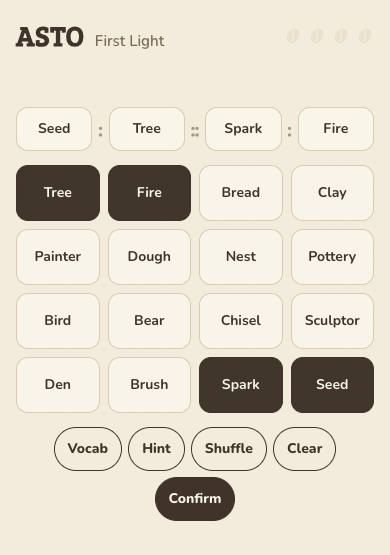
An ASTO board with Seed, Tree, Spark and Fire placed in order in the answer frame, the four chosen tiles darkened, and the Confirm button ready.
  1. Select four words, in order.
  2. Read them back in the frame: A is to B as C is to D.
  3. Confirm when both pairs share one relationship.
A game screen, with Seed, Tree, Spark and Fire in the answer frame
03 / Designing the authoring system

A good puzzle needed more than a generator.

I couldn’t consistently author analogies that met my own standards for challenge, interest, and sound reasoning. AI made it possible to explore the concept, but its output needed scrutiny.

I split the work into specialized roles: generating pairs, assembling boards, checking relationships, challenging alternate readings, and evaluating the playing experience.

Code checks structural rules. Agents provide critiques. I play every published puzzle and make the final editorial decision.

  1. 1Generate and assembleAI agentsCandidate pairs, grouped into a board
  2. 2Check and challengeCodeAI agentsCode checks structural rules; agents critique and look for other readings
  3. 3Human playtest and editMeI play the board and revise what needs work
  4. 4Approve for publicationMe onlyAgents can’t approve or publish a board

When a board needs it, it goes back for revision. Not every board takes the same path.

04 / Learning what makes a puzzle satisfying

Different on paper. Too similar in play.

Early puzzles repeatedly used relationships in which one thing becomes or produces another. A corpus analysis found that roughly 80% of the pairs authored at that point followed this pattern.

I introduced an established analogy taxonomy to broaden the range. But formally different categories still felt repetitive when every relationship suggested a direction or progression.

A blind comparison helped me find a more satisfying mix of directional and non-directional relationships. I treated that result as a working hypothesis to keep testing.

Directional “The night creature and the signal it gives off.” Each pair points one way: a creature, then what it sends out.
Non-directional “The one thing it can never have.” No before and after: each pair names something that’s missing.
Two sets from the process presentation, illustrating the mix. They show the finding, not the whole experiment.
05 / Bringing it together

A playable game, backed by an editorial system.

I brought together the game concept, interaction design, visual direction, and AI-assisted development, then built a Review Studio to make puzzle evaluation part of the workflow.

There, I can play candidate boards, inspect agent reports, record feedback, edit puzzles, and approve them for publication.

The evaluators don’t always agree with me. Measuring those disagreements helped me understand where their feedback was useful and where the final decision needed to remain mine.

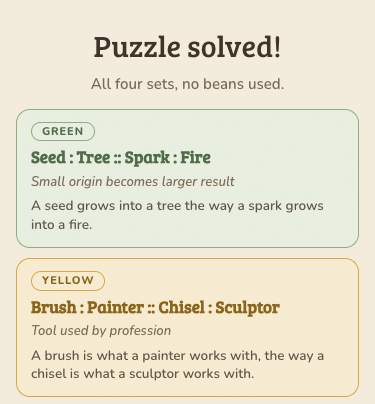
What players see ASTO’s Puzzle solved screen, showing the solved green and yellow sets with their relationships and explanations.
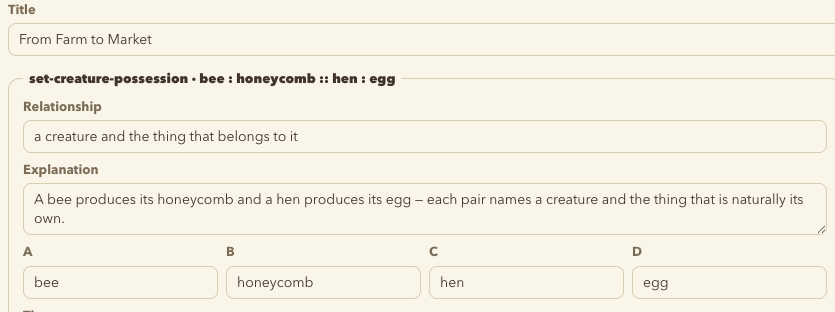
Where I edit and approve The Review Studio editor for the board From Farm to Market: its title, and one set’s relationship, explanation and four words, all editable.

Review Studio editor, from the process presentation

The project

ASTO is a browser word puzzle in which sixteen words hide four analogies. Players find two pairs that share a relationship and arrange them into “A is to B as C is to D.”

The idea came from playing NYT Connections and noticing comparisons that weren’t part of the intended solutions. Its four-word format suggested a different challenge: finding a relationship that repeats across two pairs.

I originated the concept, designed the game experience, and directed AI-assisted development. To create its puzzles, I developed a pipeline of specialized agents and a Review Studio where I play, evaluate, revise, and approve boards before publication. The project became my capstone for a course in multi-agent AI development.

ASTO in 15 seconds